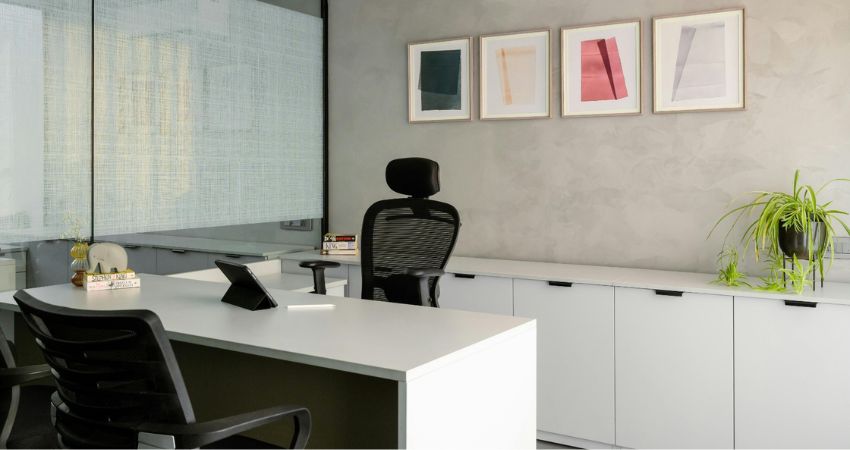
In the contemporary corporate landscape, the director’s cabin has undergone a radical transformation. Moving away from the heavy, dark-wood aesthetics of the past, the modern executive office now prioritizes mental clarity, transparency, and high-functioning minimalism. This shift is perfectly encapsulated in the featured executive suite, which serves as a masterclass in “quiet luxury” and professional efficiency.
A director’s office is the cockpit of the organization; it is where the most critical decisions are made and where the company’s highest values are physically expressed to visiting partners. By analyzing the clean lines and thoughtful textures of this space, we can identify the core principles for designing a high-impact, modern director’s cabin.
1. The Power of a Neutral Palette
The most striking element of this cabin is its commitment to a monochromatic, neutral color scheme.
- Grey Tones and Focus: The walls are finished in a soft, textured grey plaster. This choice is psychologically significant; neutral tones reduce visual “noise,” allowing a director to focus on complex tasks without environmental distraction.
- Crisp White Accents: The long side-credenza and the primary executive desk are finished in a matte white. White surfaces act as light reflectors, ensuring that even on overcast days, the workspace remains bright and energizing.
- Black Contrast: Black ergonomic chairs and slim cabinet hardware provide necessary visual “anchors”. Without these dark accents, a white-and-grey room can feel ungrounded or sterile.
2. Streamlined Storage: The Floating Credenza
A director’s cabin must be free of clutter to maintain an aura of organized authority. The storage solution in this image is a perfect example of functional minimalism.
- Low-Profile Design: The storage units are kept at waist-height, running the entire length of the back wall. This provides ample space for filing and resources while keeping the upper half of the wall open and airy.
- Clean Lines: The handle-less or slim-pull design of the cabinets maintains a seamless architectural look. In 2026, the trend is toward “hidden” storage that integrates into the wall rather than standing out as furniture.
- Surface Utility: The top of the credenza acts as a secondary workspace or a gallery for personal items like books and plants, keeping the primary desk strictly for active work.
3. Transparency and Privacy: The Glass Partition
Modern executive offices increasingly utilize glass to signal a culture of transparency and accessibility.
- The Frosted Gradient: To balance the need for focus with the desire for openness, the glass wall in this cabin features a subtle, textured frosting. This provides visual privacy for documents on the desk while still allowing light and a sense of connection to the outer office.
- Black Framing: The slim black metal frame of the glass wall adds a sophisticated, industrial edge that ties in with the room’s other black accents.
4. Ergonomics for the Modern Leader
A director often spends more time in their cabin than anywhere else. High-performance seating is not a luxury; it is a necessity for physical and mental endurance.
- The Mesh-Back Executive Chair: The primary chair features a high-back mesh design with integrated headrests. Mesh is superior for climate control and provides dynamic lumbar support that adjusts as the director moves.
- Guest Seating: The guest chairs are lower-profile versions of the executive chair, maintaining design continuity while clearly establishing the “hierarchy of the room”.
5. Curating the “Human” Element
A minimalist office risks feeling cold unless it is “warmed up” with carefully curated personal touches.
- Biophilic Accents: A vibrant spider plant in a black pot adds a splash of organic color and life to the room. Greenery is essential in executive suites for stress reduction and air purification.
- Minimalist Art: Four framed abstract prints are arranged in a precise grid on the main wall. This adds a sense of personal taste and culture without overwhelming the space with large-scale, distracting imagery.
- Meaningful Objects: Small decorative items, such as a grey elephant figurine and a stack of influential books, provide “soul” to the room.
6. Climate and Technology Integration
In high-end interior design, functional technology should be present but unobtrusive.
- Integrated HVAC: A modern, sleek air conditioning unit is mounted high on the wall, finished in a matching white to blend into the upper visual field.
- Digital Workspace: The desk is kept clear, utilizing a tablet and stylus for active work. This shift toward paperless operations is the ultimate facilitator of the minimalist aesthetic.
How to Recreate This Look in Your Office
If you are looking to refresh your executive suite, you can borrow these three core ideas from the featured image:
Step 1: Texturize Your Walls
Instead of a flat coat of paint, consider a Venetian plaster or a subtle textured wallpaper in light grey. This adds depth and a “designer” feel to the room for a relatively low cost.
Step 2: The Linear Storage Strategy
Replace bulky bookcases with a long, low-profile cabinet run that stretches from wall to wall. This creates a powerful horizontal line that makes the room feel wider and more organized.
Step 3: Curate Your “Personal Grid”
Select four related pieces of art or photography and frame them identically. Hang them in a tight grid pattern to create a sophisticated focal point that feels intentional and structured.
Conclusion: Designing for the Future of Leadership
The director’s cabin in the image is a testament to the idea that simplicity is the ultimate sophistication. By prioritizing light, texture, and organization, the space becomes a sanctuary that supports the heavy cognitive load of executive leadership.
In the year 2026, true luxury isn’t about how much you can fit into a room; it’s about the quality of the space you leave empty. This cabin proves that a clear desk and a clear room are the first steps toward a clear and decisive mind.