In the choreography of home design, the bedroom is the final movement—a place where the day’s crescendo fades into a quiet, restorative hum. The provided image of this contemporary bedroom interior is a masterclass in how modern design can feel both cutting-edge and profoundly cozy. It moves away from the sterile “hospital-white” minimalism of the past decade and embraces a richer, more textural palette that defines the “Contemporary Warmth” trend of 2026.
Let’s dissect the anatomy of this room to understand how its individual components—lighting, geometry, and texture—work together to create a sanctuary for the modern soul.
1. The Power of “Greige” and Earthy Undertones
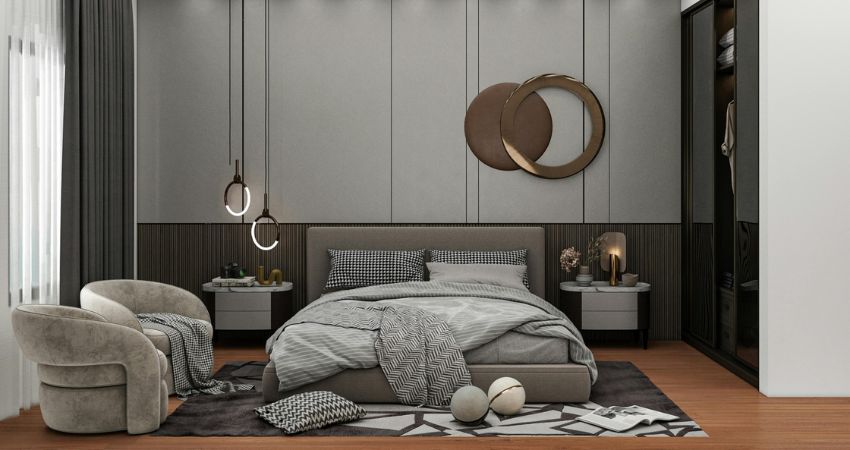
The first thing that strikes the viewer is the sophisticated color story. The room avoids stark blacks and whites, opting instead for a gradient of charcoal, stone grey, and muted taupe (greige).
- Vertical Visual Interest: The back wall is divided into two distinct sections. The upper portion features large, clean panels in a soft grey, while the lower wainscoting-style section uses dark, vertical fluted wood. This “slat wall” texture is a massive trend right now because it adds depth and acoustic dampening without cluttering the space.
- Warmth Through Flooring: The rich, honey-toned wooden floor acts as the “heat source” for the room’s visual temperature. Without this natural wood, the greys might feel too cold. The contrast between the cool walls and the warm floor creates a perfect equilibrium.
2. Geometric Play: Circles in a Linear World
Modern design often suffers from being “too boxy.” This room solves that problem through the intentional use of circular motifs, which soften the hard lines of the bed and walls.
The Interlocking Wall Art
The focal point above the headboard is a pair of interlocking rings—one solid bronze-toned disc and one metallic hoop. This art piece serves several purposes:
- Movement: The overlapping circles suggest a sense of flow and connection.
- Material Contrast: The metallic sheen of the hoop adds a touch of “quiet luxury” against the matte wall panels.
- Balance: It breaks the verticality of the wall panels, drawing the eye across the room rather than just up and down.
The Pendant Halo Lights
Suspended over the left nightstand are two glowing “halo” pendants. These are a brilliant alternative to traditional bedside lamps. By hanging them from the ceiling, the designer has freed up valuable surface area on the nightstand while creating a futuristic, ethereal glow that acts as functional art.
3. Tactile Minimalism: The Art of Layering
Minimalism isn’t about having nothing; it’s about having the right things. This bedroom excels in textural layering, which makes the bed look inviting rather than just decorative.
- Patterns with Purpose: The bedding features a mix of subtle pinstripes and bold houndstooth patterns on the pillows. Mixing scales of patterns (fine lines vs. chunky blocks) is a pro-level styling tip that prevents a monochromatic room from looking flat.
- The “Cloud” Chair: To the left, the curved, plush armchair with its heavy-knit throw blanket creates a secondary “zone” within the room—a reading nook. Its organic, rounded shape mimics the wall art and lighting, reinforcing the room’s design language.
- Sculptural Accents: Even the rug and floor accessories contribute. The geometric rug provides a grounding pattern, while the spherical floor ornaments near the foot of the bed add a touch of whimsical, gallery-like sophistication.
4. Wardrobe Integration: The “Invisible” Storage
Storage is the enemy of tranquility. In this interior, the wardrobe is integrated so seamlessly that it feels like part of the architecture.
The dark-framed glass doors of the closet (on the right) allow for a “boutique” feel. With internal LED strip lighting, the clothes themselves become part of the decor. This encourages the inhabitant to keep their belongings organized—a psychological trick that promotes a clutter-free mind. The use of dark, reflective glass adds a sense of mystery and expands the perceived size of the room.
5. Lighting Layers: From Task to Mood
A well-designed bedroom needs three types of light, all of which are present here:
- Ambient Light: Provided by the recessed ceiling spotlights that wash the wall panels in a soft glow.
- Task Light: The halo pendants provide enough light for nighttime reading.
- Accent Light: The small, sculptural gold lamp on the right nightstand and the internal wardrobe lights create pockets of warmth, ensuring there are no “dead” dark corners in the room.
6. How to Recreate This Look at Home
You don’t need a professional architect to capture this essence. Here are four steps to bring this modern aesthetic to your own bedroom:
Step 1: Tone Your Palette
Pick three shades of grey or taupe and one “natural” element (like oak or walnut). Use the darkest shade for your textures (like fluted panels or pillows) and the lightest for your main walls.
Step 2: Invest in a “Hero” Light
Swap out your standard bedside lamp for a statement pendant or a sleek, arched floor lamp. Look for “ring” or “halo” designs to replicate the soft, circular glow seen here.
Step 3: Mix Your Textiles
Don’t buy a “bed-in-a-bag” set. Instead, buy individual pieces: a striped duvet, houndstooth shams, and a chunky knit throw. The goal is to make the bed look like a collection of textures rather than a single unit.
Step 4: The Rule of Circles
If your room feels too “sharp” or “square,” add three circular items. It could be a round mirror, a circular rug, or spherical vases. This immediately creates a more relaxing, organic atmosphere.
7. The Psychology of the Modern Sanctuary
In 2026, our bedrooms have become more than just places to sleep; they are filters. They filter out the digital noise, the work stress, and the chaos of the outside world.
This specific design works because it prioritizes visual silence. There are no shouting colors or chaotic piles of “stuff.” Every object, from the marble-topped nightstands to the decorative spheres on the floor, has a designated place. This level of order has been proven to lower heart rates and prepare the brain for deeper, more restorative REM cycles.
Conclusion: A Space for the Future
This bedroom interior is a testament to the idea that luxury isn’t about excess; it’s about the quality of the environment. By balancing masculine textures (wood and metal) with feminine shapes (circles and plush fabrics), the designer has created a gender-neutral, timeless space that feels like a glimpse into the future of home living.
It is a room that doesn’t just look good on a screen—it feels good to inhabit. It invites you to put down your phone, wrap yourself in a pinstriped duvet, and simply be.